
Achieving great results from a hair transplant isn’t just about moving as many hairs as possible—it’s about creating the illusion of density using the right techniques, math, and a bit of artistry.
The Real Challenge: Supply vs. Demand
The biggest challenge in hair transplant surgery is matching the limited supply of donor hair with the amount of hair needed to restore bald areas.
As you lose hair, the number of follicular units (FUs) on your scalp stays the same—but the number of hairs within each unit drops, until none remain. That’s why hair begins to look thinner even though hair follicles are still present.
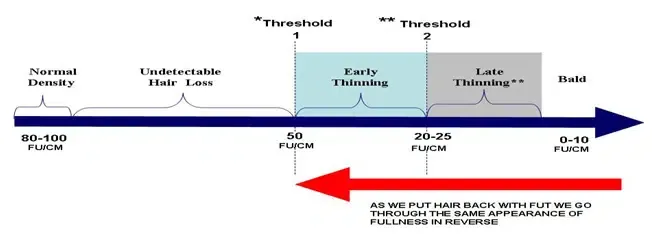
Hair can start to look noticeably thin when density drops below 50 FUs per cm², depending on:
- Hair texture (straight vs. curly)
- Hair caliber (fine vs. thick)
- Color contrast between hair and scalp
So while someone with thick, curly, blonde hair may lose 60% of their hair before it’s obvious, someone with fine, straight, dark hair might notice thinning after losing just 40%.
How Much Hair Density Is Needed to Look Full?
In the early stages of hair thinning, density typically ranges from 25 to 50 follicular units per square centimeter (FU/cm²). At this stage, your hair might still look full in some settings—like when it’s dry or under soft lighting—but appear noticeably thinner when it’s wet or under bright light. As density drops closer to 25 FU/cm², the thinning becomes more obvious in everyday situations.
A well-performed hair transplant can add density where it’s needed. For example, if your scalp has 25 FU/cm² before surgery and we add another 25 FU/cm², you reach 50 FU/cm². This is often enough to make the area look visibly full and natural in most situations.
However, keep in mind that the higher your original hair density was, the harder it is to recreate that look if you’ve experienced significant hair loss. If you’ve lost most of your hair (down to 0–25% of your original density), reaching 40–60% of your former density may require multiple procedures.
Trying to exceed that level—restoring more than 60%—usually won’t make a dramatic difference in appearance but can overuse donor hair, which is limited and may be needed for future treatments. The goal isn’t to replace every lost hair but to create the illusion of fullness using strategic placement and smart density planning.
Why More Isn’t Always Better
When it comes to hair density, more isn’t always better—and perfection isn’t the goal. It’s about creating the illusion of fullness that looks completely natural in real-life settings.
Wanting full, thick hair is completely normal—but trying to “pack in” too many grafts in a small area can backfire. Here’s why surgeons don’t recommend going beyond 40 grafts per cm² in most cases:
Reduced Graft Survival
Just like planting seeds too close together, crowding hair grafts can choke off their blood supply.
- Studies show over 90% survival when placed at 30–35 grafts/cm²
- But when density goes beyond 40 grafts/cm², survival rates drop significantly
More Trauma, Less Healing
High-density packing can:
- Damage the scalp and nearby grafts
- Disrupt blood flow
- Delay healing or, in worst cases, lead to scalp necrosis
Overharvesting the Donor Area
Trying to achieve ultra-high density often means pulling more grafts than necessary.
- This can thin out the back and sides of your scalp—the “safe zone” for future procedures
- Once those grafts are gone, they’re gone
The Density Sweet Spot: 30–40 Grafts per cm²
Restoring 30 to 40 follicular units per square centimeter is considered the optimal range for a natural, full appearance:
- Looks full in social situations
- Appears dense from a normal distance
- Mimics the natural hair pattern
- Conserves donor hair for future use
This is the “real-world full”—how your hair looks across the table at dinner, in a selfie, or walking down the street.
But What About Under a Microscope?
Even people without hair loss may show a bit of scalp under:
- Bright lighting
- Wet hair
- Close-up, critical self scrutiny
So yes, some scalp visibility is normal—and expected—even after a great transplant.
If You Expect Zero Scalp Showing…
You may be setting yourself up for disappointment. Hair restoration isn’t designed to hide every square inch of scalp in every condition. It’s meant to restore confidence and natural density, not create artificial perfection.
Social media often shows off perfect hairlines and full results, but keep in mind:
- Photos may be filtered, edited, or taken under ideal lighting
- Many patients undergo multiple surgeries to achieve those looks
Hair transplants are about creating the illusion of fullness, not chasing perfection. A realistic goal? A natural-looking, fuller appearance that holds up well in everyday lighting, movement, and conversation.
What Else Affects Hair Transplant Density?
It’s not just about how many grafts you get. A number of factors—some you can control, and others you can’t—play a role in how full your hair will look after surgery.
Size of the Area to Cover
The bigger the balding area, the more grafts you’ll need. But there’s only so much donor hair available. So in large areas, your surgeon may prioritize coverage over maximum density. It’s a balance between how much you can cover and how full it can look.
How Much Native Hair Is Left
If only 20–25% of your original hair is still present in the thinning area, it takes more grafts to rebuild density. That’s because transplanted hair has to do all the heavy lifting.
Medical Conditions That Affect Blood Flow
Conditions like:
- High blood pressure
- High cholesterol
- Diabetes
These medical conditions can reduce blood flow to your scalp, which affects graft survival and overall results.
Scalp Health & Skin Condition
If your scalp has:
- Seborrheic dermatitis or psoriasis
- Scarring from previous surgery, trauma, or sun damage
- Thinner or less flexible skin due to aging
These scalp conditions may reduce the number of grafts that can safely survive. Sun-damaged scalps—especially in patients bald for years—tend to have weaker blood supply, making it harder for transplanted hairs to “take.”
Lifestyle & Nutrition
Poor diet, nicotine/tobacco use, or heavy alcohol intake can:
- Slow healing
- Lower graft survival
- Impact long-term results
Your Perception of “Fullness”
If you struggle with body dysmorphic disorder or tend to fixate on small flaws, it’s important to have honest conversations with your surgeon. What looks full and natural to others may still feel “thin” to you—even if the transplant is successful.
Bottom Line
Hair transplant results aren’t one-size-fits-all. Everything from your health and hair characteristics to your scalp condition and expectations can influence the final outcome. That’s why a personalized consultation with an experienced hair loss specialist like Dr. Yaker is key. A good surgeon will walk you through what’s realistically achievable—and craft a plan tailored specifically to you and your future.