
Hair Development
Hair grows during fetal development from the 14th to 15th week of pregnancy. At this stage, hair follicles begin to form in the skin, and a fine, soft type of hair called lanugo starts to develop. Lanugo protects the baby’s skin and helps regulate body temperature while the baby is in the womb. This delicate hair is usually shed before birth or shortly after and is replaced by more permanent types of hair, known as vellus hair (soft and fine) or terminal hair (thicker and pigmented).
Hair Growth Rates
- Asian hair, the most common hair type globally, grows at the fastest rate, averaging approximately 0.5 inches per month
- Caucasian and European hair grows at an average rate of 0.4 inches per month and has the highest hair density
- African American hair grows slightly slower, averaging approximately 0.3 inches per month
Hair Cycles
Hair growth occurs asynchronously and individually for each follicle through a continuous process known as the hair growth cycle. Each follicle operates independently, cycling between growth and shedding, completing about 10 to 30 cycles in a lifetime. With approximately 100,000 to 150,000 scalp hairs at any time, normal daily shedding of up to 100–150 hairs is typical and part of the natural cycle.
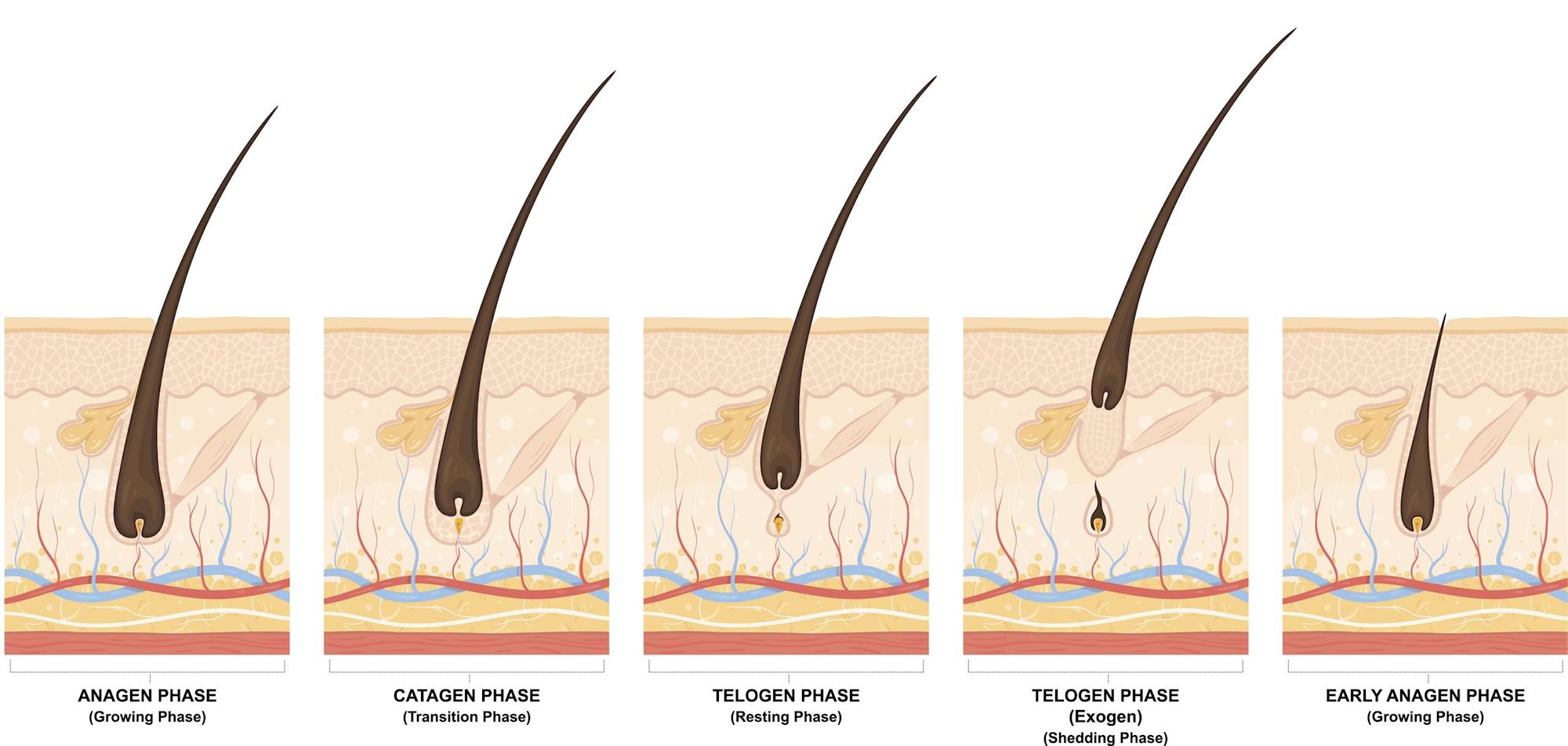
The Four Stages of the Hair Growth Cycle
- Anagen (Growth) Phase
The anagen phase is the active growth stage, where new hair forms and pushes out older, inactive club hairs. About 90% of scalp hairs are in this phase at any given time, lasting 2–6 years for most people. During anagen, hair grows approximately 0.5 inches per month (6 inches per year), often growing faster in the summer than in winter. The duration of anagen varies by hair type and location; scalp hair has a more extended growth phase, while hairs on arms, legs, eyelashes, and eyebrows grow for only 30–45 days, resulting in shorter lengths. Disruptions to the anagen phase can prevent hair from reaching its full potential, which is why some individuals cannot grow long hair - Catagen (Regression) Phase
The catagen phase is a brief transitional stage where 1–2% of hairs stop growing. This phase lasts approximately 2–3 weeks and involves the detachment of hair from its blood supply and the stem cells responsible for new growth. The lower part of the hair follicle regresses, temporarily stopping hair production - Telogen (Resting) Phase
This is the final stage of the hair growth cycle, lasting approximately 2–3 months and involving about 10–15% of all hairs at any given time. During this phase, the hair is in a resting state, and at the end of the phase (exogen), the hair shaft naturally detaches, marking the start of a new hair growth cycle - Exogen (Shedding) Phase
The exogen phase is the final stage of the scalp hair cycle, where the hair strand is naturally shed from the follicle. This phase is often considered an extension of the telogen phase (the resting phase) and marks the point at which the old hair is released to make room for new growth
Shed hairs from this phase often have a small, white bulb made of keratin at the root, frequently mistaken for the actual hair root. However, true hair roots remain intact unless they are removed through actions such as overplucking.
Hair loss conditions, such as androgenetic alopecia, lead to baldness not because the roots fall out, but because the hair follicles (roots) become inactive, and new skin seals over the hair pore. If a shed hair has no white bulb, this is typically a sign of breakage rather than natural shedding. Understanding this process helps differentiate between normal hair shedding and hair damage.