
The FDA approved oral dutasteride 0.5mg in 2001 for the treatment of symptomatic benign prostatic hyperplasia (enlarged prostate). While dutasteride is not FDA-approved for hair loss in the US, it is approved in South Korea (2009), Taiwan (2009), and Japan (2015) for the treatment of androgenetic alopecia.
Off-Label Uses
Oral dutasteride is prescribed off-label for male and female androgenetic alopecia (genetic hair loss). Several clinical trials showed significant evidence in support of dutasteride’s ability to treat men with mild-to-moderate androgenetic alopecia effectively when compared to oral finasteride. This was not only in comparison to placebo but also in comparison to finasteride.1,2,3,4
Oral dutasteride is also used off-label to treat frontal fibrosing alopecia (FFA), a form of scarring alopecia. Studies show the medication was able to help stabilize hairline recession in 62% of users.5,6
How Does Dutasteride Work?
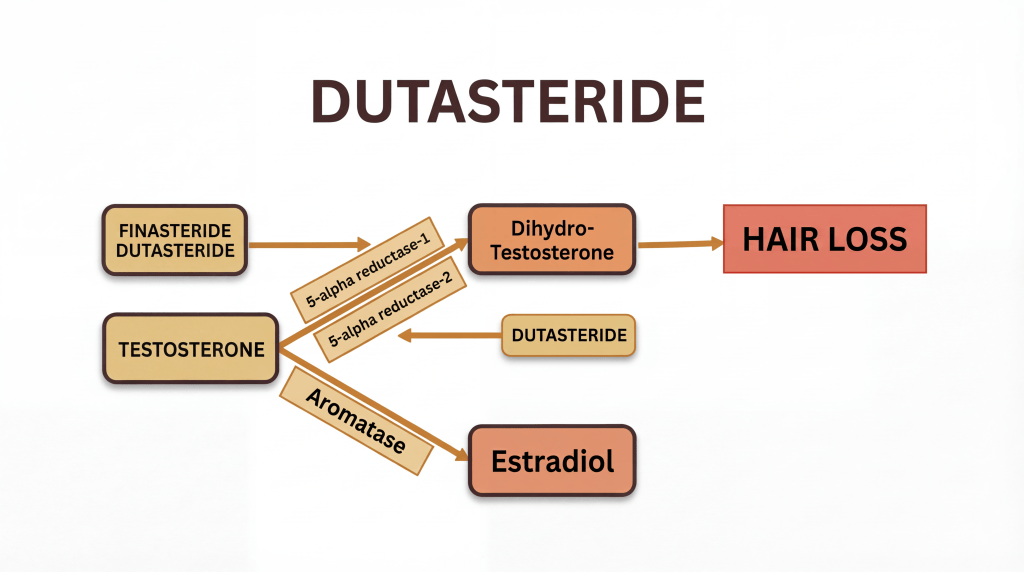
Like finasteride, dutasteride is a 5-alpha reductase inhibitor, blocking the enzyme 5-alpha reductase, which converts testosterone into dihydrotestosterone (DHT), a hormone that contributes to hair loss.
While Finasteride blocks Type II 5-alpha reductase, the enzyme most active within hair follicles, Dutasteride blocks both Type I and Type II. It is significantly more potent—about 100× stronger than finasteride at inhibiting Type I and 3× stronger for Type II. While both enzymes contribute to DHT production, Type II plays the dominant role in hair follicle miniaturization because it is the primary isoenzyme located in the dermal papilla—the part of the follicle that drives androgen sensitivity. Dutasteride’s broader and stronger inhibition leads to greater overall DHT reduction and improved treatment outcomes.7
Oral Dutasteride
0.5mg oral dutasteride is becoming a popular treatment option for androgenetic alopecia (AGA) due to its positive results in various randomized controlled studies and meta-analyses. Many of these studies have shown that dutasteride is more effective than finasteride, while having similar side effect profiles.
Oral dutasteride leads to a 90% reduction in DHT levels in the bloodstream, compared to a 70% reduction with finasteride.8,9
Approximately 60% of oral dutasteride is absorbed into the bloodstream, and taking the drug with food improves its absorption. Absorption of dutasteride occurs around 2-3 hours after taking the dose and is essentially complete 6 to 8 hours after the dose.
The half-life (time it takes for half of the drug to leave your body) of dutasteride is significantly longer, approximately five weeks, compared to just 6-8 hours for finasteride. While sexual side effects are comparable between the two drugs, according to several studies, given dutasteride’s longer half-life, if side effects do occur, they may persist for a more extended period before the drug is fully cleared from the system.
Topical Dutasteride
One of the main arguments for using topical dutasteride is to avoid the systemic side effects of the drug. Clinical trials in Spain for topical dutasteride are currently underway.
Mesotherapy with Dutasteride
Mesotherapy is a technique where 0.01% to 0.05% dutasteride is superficially injected into the scalp over multiple sessions. Because topical dutasteride may have difficulty penetrating the skin effectively due to its larger molecular size, mesotherapy allows the drug to reach the hair follicles more efficiently, potentially offering better hair growth results than just applying it on the skin’s surface. Injectable dutasteride has also become increasingly popular because it limits the drug’s absorption into the bloodstream, leading to fewer systemic side effects.
Several clinical trials have shown improved hair density, reduced hair loss, and better scalp coverage, all with a favorable safety profile.10,11,12
A meta-analysis comparing the sexual side effects of oral dutasteride and dutasteride injected into the scalp versus placebo for treating androgenetic alopecia (AGA) found no reports of sexual side effects with the intralesional dutasteride treatment. This suggests that sexual side effects are not a significant concern with mesotherapy injections of dutasteride.
Effectiveness of Oral Dutasteride
Due to its ability to inhibit both types of 5-alpha reductase enzymes, dutasteride is generally considered more effective in reducing scalp and serum DHT levels. Some studies have shown that dutasteride can result in greater hair regrowth and density than finasteride as well.
In Men
A meta-analysis showed that dutasteride provides a better efficacy compared with finasteride in treating AGA. The two drugs appear to show similar rates of side effects, especially regarding sexual dysfunction.
In Women
In a 3-year study involving 3,500 women under the age of 50 with androgenetic alopecia, participants were prescribed either 0.15 mg of dutasteride or 1.25 mg of finasteride. Results showed that approximately 83.3% of women in the dutasteride group experienced a significant improvement in hair thickness as compared to the finasteride group (81.7%).
Olsen et al. reported that oral dutasteride successfully treated female pattern hair loss with no side effects at doses that range from 0.25 to 0.5 mg daily.
This case study described a female patient with androgenetic alopecia (AGA) who initially did not respond to minoxidil. However, she showed some benefit from using finasteride. Given her continued hair loss and persistent AGA, the patient was started on oral dutasteride. After six months of dutasteride treatment, clinical assessments demonstrated significant improvement in her hair density with no reported side effects, highlighting the potential effectiveness of dutasteride for cases where other treatments like minoxidil and finasteride are less effective.
Post-Menopausal Women
In a study focusing on postmenopausal women experiencing female pattern hair loss, they were treated with 0.25mg of oral dutasteride per day. Here’s what the study found:
- After one year of treatment, 60% of women showed noticeable hair growth, especially in the front and sides of the head (frontotemporal area). Later, improvements were also seen in the top (crown) and the front part of the scalp.
- After two years of treatment, 80% of women had even better results, with continued hair growth in these areas.
Topical Dutasteride
Early research involving topical dutasteride seems promising and suggests reduced side effects while still delivering hair benefits. Topical dutasteride is currently undergoing phase 2 clinical trials in the US to establish its safety and efficacy for men with male pattern baldness.
Intermittent Therapy
Dutasteride is commonly prescribed at 0.5 mg daily for hair loss, though it can also be taken off and on, such as twice a week. Studies have shown no significant difference in the likelihood of side effects between dutasteride and finasteride. Both drugs are effective for hair loss treatment and choosing which to use depends on individual needs and preferences.13
Comparison of Oral Finasteride and Dutasteride
This study compared the efficacy, safety, and tolerability of dutasteride and finasteride for men with androgenetic alopecia (AGA). The findings demonstrated dutasteride was more effective at promoting hair growth than finasteride, while having comparable side-effect profiles. This suggests that dutasteride may be a more potent option for treating AGA, especially for patients who may not have responded well to finasteride.
A meta-analysis found that daily use of 0.5 mg of oral dutasteride led to a greater increase in total hair counts after 24 weeks compared to 1 mg of oral finasteride.
This study comparing the effectiveness, safety, and tolerability of dutasteride and finasteride for treating androgenetic alopecia in men found that dutasteride users experienced a 10% improvement in thin hair count, compared to no improvement in the finasteride group. Additionally, the percentage of thick hair increased by 18.71% with dutasteride, compared to only 3.67% with finasteride. Photographic assessments also revealed that most participants using dutasteride showed great or significant changes in hair density and appearance.
That said, dutasteride isn’t always the best or first option for treating hair loss. Finasteride is a more established treatment and may work just as well for you.
Side Effect Comparison: Finasteride versus Dutasteride
A 2014 multicenter study compared the effects of different doses of dutasteride (0.02 mg, 0.1 mg, and 0.5 mg), finasteride (1 mg), and placebo in 917 men aged 20 to 50 with androgenetic alopecia (hair loss). Dutasteride 0.5 mg significantly increased hair growth compared to finasteride 1 mg and placebo, with similar rates of sexual side effects among the groups. Additionally, sexual side effects tended to decrease over time.
In a study by Olsen et al., different doses of dutasteride (0.05 mg, 0.1 mg, 0.5 mg, and 2.5 mg) were compared to finasteride 5 mg for treating androgenetic alopecia.. The study showed that dutasteride 0.5 mg was significantly more effective at promoting hair growth than finasteride 5 mg after 24 weeks. Additionally, the 2.5 mg dutasteride dose was even more effective at boosting hair growth than the 0.5 mg dose.
Regarding side effects, the rates of decreased libido, ejaculation issues, and impotence were reported as follows:
- Dutasteride 2.5 mg: 13%, 1%, and 0%
- Dutasteride 0.5 mg: 1%, 1%, and 0%
- Finasteride 5 mg: 4%, 3%, and 1%
- Placebo: 3%, 0%, and 5%
Of the 13% of participants in the dutasteride 2.5 mg group who reported decreased libido, four had their symptoms resolved during treatment. One person recovered within three weeks of stopping therapy, and another within eight weeks. Only one patient experienced persistent decreased libido after stopping but did not attribute it to the drug.
Based on these findings, the authors suggest that while the standard daily dose of dutasteride is 0.5 mg for treating benign prostatic hyperplasia (BPH), the 2.5 mg dose—though not FDA-approved for hair loss and used off-label—may have a greater therapeutic effect because of its stronger ability to reduce DHT levels.14
If Oral Finasteride is Not Working, Should I Consider Oral Dutasteride?
Given dutasteride’s superiority to oral finasteride for treating androgenetic alopecia and with similar safety profiles, patients who have not responded or have plateaued with oral finasteride should consider discussing switching to dutasteride with their hair loss specialist.
This study demonstrated that men with androgenetic alopecia (AGA) who did not respond to finasteride 1 mg daily for at least six months showed significant improvement when switched to dutasteride at 0.5 mg daily. After six months of treatment with dutasteride, over 77% of these patients experienced a positive response.
Fertility Concerns with Dutasteride
The impact of dutasteride on fertility has yet to be extensively researched. However, early studies suggest that it may cause slight reductions in semen parameters, such as sperm count, motility, or volume, while the medication is being used. This effect is similar to what has been observed with finasteride. It is important to note that these changes in semen parameters are generally mild and are reversible upon discontinuation of the drug. However, further studies are needed to provide more comprehensive insights into the long-term effects of dutasteride on fertility.
Side Effects with Dutasteride
It is commonly accepted that finasteride and dutasteride show similar efficacy and sexual safety profiles. Several studies have shown no significant difference between the two medications.15,16
Most researchers agree that the side effects of dutasteride are minimal, with only a small percentage of users experiencing adverse reactions. For example, one study found that 4.7% of male users experienced erectile dysfunction, 3% reported decreased libido, and 1.4% had issues with ejaculation.
A large meta-analysis involving over 6,000 patients found no significant difference in sexual dysfunction between those taking dutasteride and those on placebo, suggesting the drug was not likely responsible for these side effects.
In fact, a smaller 2020 study reinforced this finding, showing that a similar percentage of patients on placebo reported sexual side effects, likely due to the nocebo effect, where concern about side effects causes patients to believe they are experiencing them.17,18
Research also indicates that most side effects occur within the first year of treatment and generally diminish afterward. Many men see side effects resolve completely once treatment is stopped. Persistent side effects after the first year are infrequent, and prolonged use has not been associated with developing new side effects. 19,20 One study showed that after four years of oral dutasteride use, the incidence of side effects that led to withdrawal was less than 1%.
For more in-depth information regarding potential side effects with DHT-blocking medications, click here.
In Women
Studies on the side effects of dutasteride have shown similar patterns to those observed with finasteride, with comparable profiles for potential adverse effects.