
Topical Minoxidil HÄR LAB No. 1
Minoxidil is an FDA-approved topical treatment used to slow hair loss and help thicken hair in people with androgenetic alopecia (commonly known as male and female pattern hair loss).
Originally developed in the 1970s as a medication for high blood pressure (marketed as Loniten®), doctors noticed an unexpected side effect—patients began to grow hair. This discovery led researchers to investigate minoxidil as a treatment for hair loss.
In 1988, the FDA approved a 2% topical solution of minoxidil (Rogaine®) for male pattern baldness, initially by prescription. A stronger 5% solution was approved in 1991, and in 1996, minoxidil became available over the counter. In 2014, the FDA extended approval of the 5% minoxidil foam for treating female pattern hair loss.
As more people seek solutions for hair thinning and baldness, the market for minoxidil continues to expand, reflecting its important role in hair regrowth treatments.
Off-Label Use
Off-label prescribing is common when new research or clinical experience suggests a medication can provide benefits beyond its original approval. When a doctor prescribes a medication off-label, they are using it to treat a condition it wasn’t initially approved for, prescribing it at a different dosage, or administering it in a different form (such as applying an oral medication topically).
Minoxidil is commonly used off-label to treat other hair loss conditions, including:
Many people think minoxidil only works on the crown, or back of the head. This misunderstanding stems from the original clinical trials, which focused only on the crown for FDA approval. However, later studies showed that minoxidil is also effective on the frontal scalp. When applied to areas with existing hair, it can help strengthen and regrow fine, thin, vellus-like hairs, often soft, colorless, or lightly pigmented due to androgenetic alopecia.
How Does Minoxidil Work?
The exact mechanism of how minoxidil treats androgenetic alopecia isn’t fully understood, but there are several theories about its effects:
- Increases Blood Flow: Minoxidil improves blood circulation to hair follicles, providing more nutrients and oxygen, stimulating hair growth
- Prolongs Hair Growth Phase: It extends the anagen (growth) phase of the hair cycle, allowing hair to grow longer and thicker
- Thickens Hair: Minoxidil helps enlarge miniaturized hair follicles, leading to thicker and stronger hair
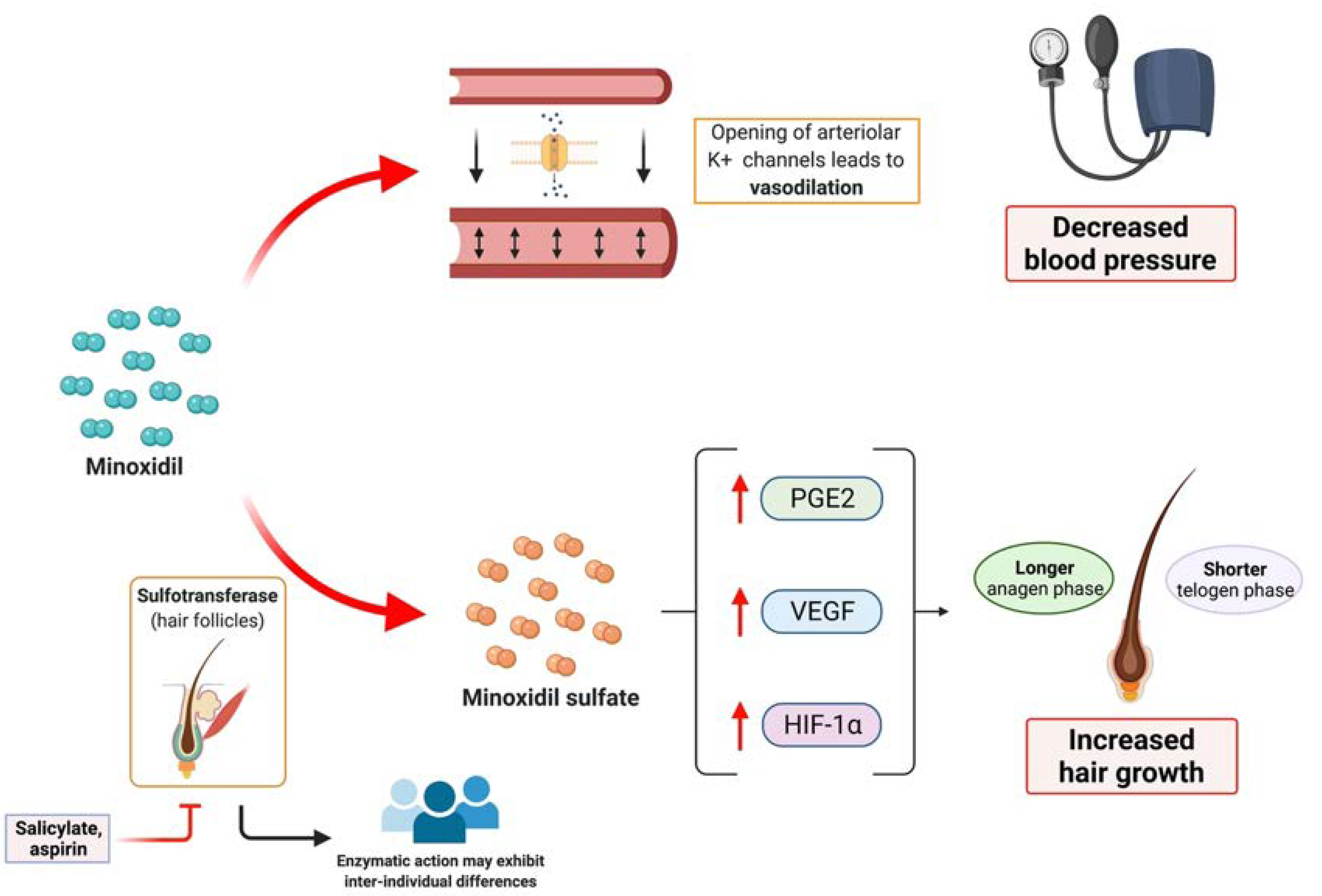
However, minoxidil alone may not be enough to effectively treat male androgenetic alopecia because it doesn’t address the root cause—DHT (dihydrotestosterone). The DHT hormone attacks sensitive hair follicles causing them to shrink and shorten their growth phase of the hair cycle. Since minoxidil doesn’t affect DHT, it works best alongside DHT-blocking treatments (finasteride, dutasteride).
Topical Minoxidil
Topical minoxidil has significantly lower bioavailability, with only 1-2% of the drug being absorbed systemically when applied to the scalp. This makes it effective in treating hair loss while greatly reducing the risk of systemic side effects.
Minoxidil comes in two topical forms:
Foam:
- Pros: It is easier to apply, less greasy, dries quickly, and is less likely to cause scalp irritation since it usually doesn’t contain propylene glycol
- Cons: Contains more alcohol than the liquid form, which can lead to dryness, flakiness, irritation, or a dry, brittle texture in the hair
Liquid Solution:
- Pros: It is often absorbed more deeply into the scalp, which may make it more effective for some users. It’s also easier to apply directly to the scalp, especially for those with longer hair, as it can be spread evenly and massaged in
- Cons: It can leave the scalp and hair feeling greasy or oily, takes longer to dry, and may cause scalp irritation or dryness due to propylene glycol
While the FDA has approved 5% as the maximum concentration for over-the-counter use, some companies offer higher doses (up to 15%) for off-label use. However, there is limited evidence that concentrations higher than 7.5% are more effective and come with a higher risk of side effects. Some companies promote the idea that “more is better” in their marketing despite these risks.
What is Propylene Glycol?
Propylene glycol is a synthetic liquid commonly used in cosmetics, food, pharmaceuticals, and industrial products. It’s clear, colorless, nearly odorless, and slightly sweet. Its primary function is to dissolve active ingredients and extend product shelf life, making it useful in pharmaceutical and cosmetic formulations to ensure ingredients are evenly distributed.
While propylene glycol is generally safe, some people may experience side effects when using minoxidil. A 2023 study demonstrated that 13.8% of users developed scalp itching.
Scalp Irritation: The most common side effect is irritation, which can cause itching, redness, dryness, or a burning sensation.
Contact Dermatitis: In more sensitive individuals, propylene glycol may cause an allergic reaction called contact dermatitis, leading to inflamed, itchy, or even blistered skin.
Most people who experience irritation from minoxidil are not allergic to the medication itself but to the propylene glycol in the formula. For those with sensitivities, using a propylene-glycol-free version of minoxidil can help reduce irritation and other scalp issues.
Topical Minoxidil Concentration and Effectiveness
A 2022 study by Singh et al. found that minoxidil’s effectiveness peaks at a 7.5% concentration. Minoxidil reaches its maximum solubility at this level, meaning it dissolves completely without leaving residue. Beyond 7.5%, the solution starts to crystallize, so higher doses don’t significantly improve hair regrowth.
Another study by Ghonemy & Bessar compared 5% and 10% minoxidil. Surprisingly, the 5% formula led to better hair regrowth than the 10% or a placebo. The 10% formula also caused more skin irritation, likely due to the higher amounts of ingredients like propylene glycol and alcohol in the stronger version. Increasing the minoxidil concentration also raises the levels of these irritating components.
Oral Minoxidil for Hair Loss
While topical minoxidil has been successful for decades, some doctors have been prescribing oral minoxidil off-label for years, especially when topical treatments aren’t effective or practical.
Oral minoxidil gained widespread attention after a 2022 New York Times article highlighted its use as an off-label treatment for hair loss. The article discussed the benefits of oral minoxidil, including easier use and better adherence to treatment. However, it also emphasized the importance of careful dosing and monitoring due to potential side effects. The article sparked increased interest from patients and doctors, leading to a rise in popularity despite its off-label status.
The dosage of oral minoxidil for hair loss is much lower than for treating high blood pressure. For hair loss, typical doses are between 0.25 to 2.5 mg daily for women and 2.5 to 5.0 mg daily for men, depending on individual response and tolerance. In contrast, for high blood pressure, the doses range from 10-40 mg daily, with a maximum of 100 mg daily.
Oral minoxidil has a bioavailability of about 90-95%, meaning most of the medication is absorbed into the bloodstream. Food does not interfere with its absorption. After taking the dose, it is absorbed rapidly, with complete absorption occurring within approximately one hour.
Oral minoxidil has several advantages over the topical version: it’s easier to take as a pill rather than applying to the scalp, avoids cosmetic issues like changing hair texture or leaving residue, and is generally cheaper than topical over-the-counter options. It’s particularly useful for those who are not compliant with the topical version or those who find topical minoxidil ineffective or irritating.
Minoxidil’s Effectiveness for Hair Loss
Minoxidil is converted into its active form, minoxidil sulfate, by an enzyme called sulfotransferase, found in hair follicles and the liver. Due to differences in this enzyme’s activity, minoxidil’s effectiveness can vary between people.
A study by Ramos et al. showed that about 60% of people have low sulfotransferase activity in their hair follicles, which can make minoxidil less effective for them. However, oral minoxidil may still work for these individuals because it relies on the enzyme activity in the liver, not just the hair follicles, making it a better option for those with low enzyme activity in their hair. Another alternative is a compounded topical formula containing minoxidil sulfate, which could be more effective for people with low hair follicle sulfotransferase enzyme activity.
Research also suggests that oral aspirin may reduce sulfotransferase activity in hair follicles, affecting how well minoxidil works for hair loss. In a study by Goren et al., sulfotransferase activity was measured in participants after 14 days of aspirin use. Initially, 50% of participants responded to minoxidil, which dropped to 27% after taking aspirin.
This study shows that minoxidil’s effectiveness can vary depending on different factors. For example, in cases of micro-inflammation in the scalp, the success rate of minoxidil drops from 77% to 55%.
Research by Suchonwanit et al. suggests that individuals who respond well to minoxidil will likely maintain its effectiveness at their current dose. However, those who do not initially respond to minoxidil are unlikely to see improvements with continued use.
Topical Minoxidil Research
For Women:
- A meta-analysis of studies on 2% minoxidil found that only 13-20% of women experienced moderate hair regrowth
- Using a 5% concentration was more effective, with 40% of women seeing hair regrowth
For Men:
- In a one-year study of 904 men with androgenetic alopecia, 62% of those using 5% minoxidil twice daily saw reduced balding, and 84.3% experienced some hair thickening
Oral Minoxidil Research
For Women:
- Doses of 0.25–1.25 mg daily effectively treated various hair loss conditions, such as Female Pattern Hair Loss (FPHL) and alopecia areata, with 61-86% improvement.1 2 3
- A study of 148 women found that 80% showed improvement with low-dose oral minoxidil.4
For Men:
- This study showed that men with androgenetic alopecia who took 2.5 or 5.0 mg daily for six months showed:Global photographic assessment (by blinded dermatologists):
- 5 mg group: ~64% of men improved5 mg group: ~62% of men improved
Patient self-assessment:- 5 mg group: ~84% reported improvement
- 5 mg group: ~92% reported improvement
Head-to-Head Studies: Oral vs. Topical Minoxidil
- Ramos et al. compared 1 mg oral minoxidil with 5% topical solution daily in women. Both treatments were equally effective, but oral minoxidil resulted in less initial hair shedding
- Penha et al. compared 5 mg oral minoxidil daily to 5% topical minoxidil twice daily for men. The oral group showed slightly better improvement in the crown area based on photographic evaluation, but overall, both treatments were similarly effective
Combination Studies: Oral with Topical Minoxidil
Some studies suggest combining oral and topical minoxidil may be a safe and effective way to treat hair loss. However, this approach is not yet a common part of clinical guidelines. Despite this, many doctors have begun prescribing low doses of oral minoxidil and topical form for conditions like androgenetic alopecia (genetic hair loss) and telogen effluvium (temporary hair thinning). This combination is often used for patients who didn’t see results from topical treatments alone.
This study found that using a combination of oral minoxidil (1.25 mg to 5 mg daily) and 5% topical minoxidil worked better for treating hair loss caused by cancer treatments than using the topical treatment alone. The combination treatment was also well tolerated, meaning most patients could use it without significant side effects.
Side Effects of Minoxidil
While minoxidil is generally well tolerated, side effects can occur, just like with any medication. Studies show that side effects may start at different times, ranging from day one to up to three months. Oral minoxidil carries a higher risk of side effects because it is absorbed into the bloodstream, whereas only about 1.4% of topical minoxidil is absorbed. The amount of minoxidil absorbed into the bloodstream can vary depending on factors such as the type of formulation used, where it’s applied, and the condition of the scalp.
The most extensive study on side effects was conducted by Vañó-Galván et al. and involved 1,404 patients (67% female and 33% male). Researchers found that only 1.2% of participants had to stop treatment due to side effects, even after trying various management methods.
Potential Side Effects of Minoxidil
- Temporary Hair Shedding: Minoxidil can shorten hair’s resting phase (telogen), which may lead to temporary hair shedding. This is more common with the topical version and usually stops with continued use
- Skin Irritation or Allergic Contact Dermatitis: Some people may experience redness, itching, flaking, or a burning sensation on the scalp. Using formulations without propylene glycol can help reduce the risk
- Worsening of Seborrhea: Minoxidil can sometimes worsen seborrheic dermatitis in about 9.5% of cases
- Excessive Facial and Body Hair (Hypertrichosis): This is the most common side effect, affecting about 5-30% of users, depending on the delivery method (topical versus oral) and dosage. Since it is dose-dependent, it typically improves with a lower dose or after stopping treatment
- Lightheadedness: Minoxidil can lower blood pressure in about 1.7% of people, leading to lightheadedness. Taking it at bedtime with a full glass of water can help reduce this risk
- Fluid Retention (Swelling): Swelling around the eyes (0.3%) or ankles (1.3%) may occur and is dose-dependent. Joint stiffness may also occur but is extremely rare
- Fast Heart Rate: Minoxidil can cause a fast heart rate in less than 1% of users, especially at higher doses
- Headaches: Around 0.4% of users may experience headaches, which usually improve with continued use
- Changes in Hair Texture or Color: Some people may notice dry, tangled hair that is more prone to breakage. Some users might experience a change in hair texture due to dried residue left on the hair and scalp, especially if the product isn’t thoroughly washed out regularly
- Rare but Severe Reactions: In patients with heart or kidney conditions, serious issues like pericarditis (inflammation around the heart), pericardial effusion (fluid around the heart), cardiac tamponade (fluid rapidly builds up around the heart, compressing it and limiting its ability to pump blood efficiently), exacerbating congestive heart failure, and worsening angina (chest pain)
Who Should Not Use any form of Minoxidil
- People with a known allergy to minoxidil or its ingredients (like propylene glycol)
- Pregnant or breastfeeding women
- Anyone under the age of 18
In addition to the groups mentioned above, the following should avoid using oral minoxidil:
- People with a history of heart disease, such as atrial fibrillation, heart failure, or a heart attack
- Patients with kidney or liver disease
- Older adults should use a lower dose because it can lower blood pressure and increase the risk of falls
Key Considerations
Everyone reacts differently to medications. Some people may experience side effects, while others may not. And for the ones that do, the severity of these effects is individualistic. It’s also important to remember that hearing or reading online about someone else’s experience does not mean you’ll have the same reaction. Negative stories are often more commonly shared, so keep that in mind when “researching.”